


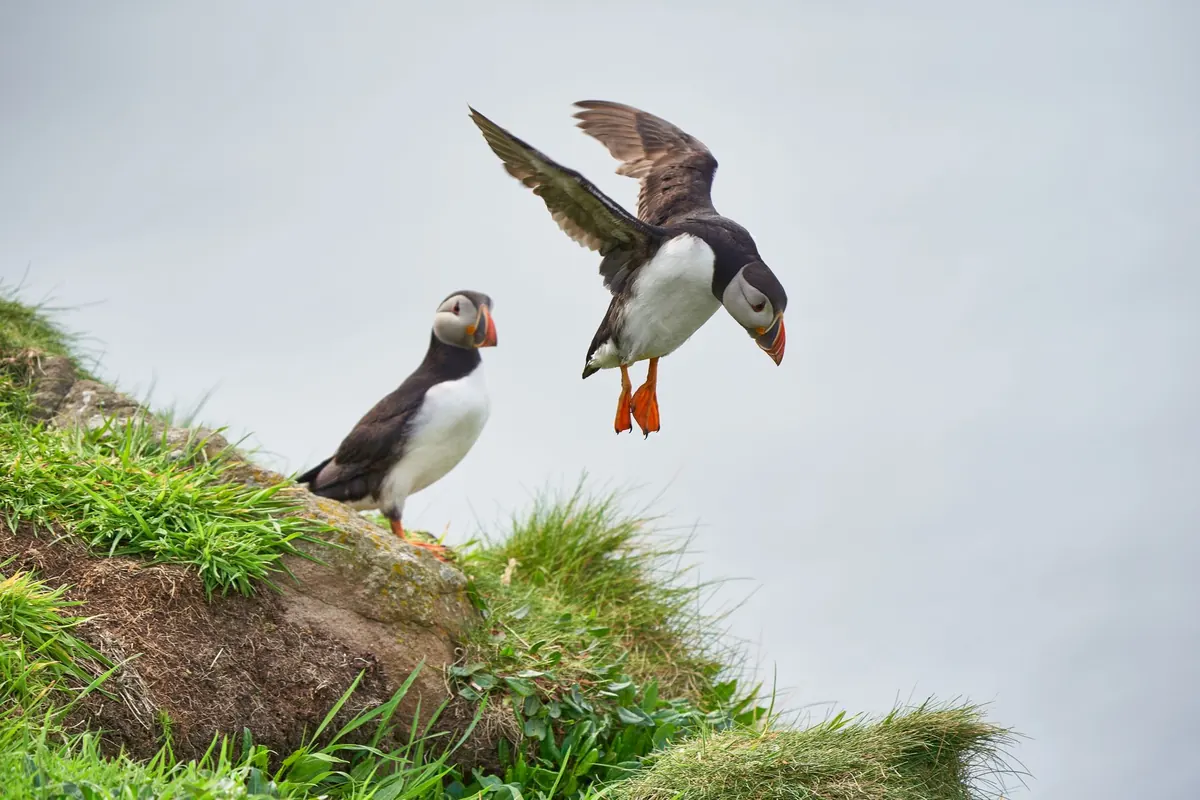
Puffins are the headliners of British seabird watching: small, comic, brightly billed and, for a few short months each year, gloriously approachable. Between roughly April and early August, Atlantic puffins crowd onto cliffs, islands and grassy slopes around our coast, and a handful of colonies let you watch them from a few metres away without getting on a boat at all. Time it right and know where to stand, and it is one of the great wildlife experiences these islands offer. Time it wrong and you will spend a morning staring at an empty sea.
The puffin year: how the season works
Puffins spend most of their lives offshore, and they come to land only to breed. The first birds usually appear back at their colonies from late March, with numbers building through April. They then spend a week or two rafting on the water just offshore before committing to land, so an early-season visit can look disappointingly quiet even when the birds are there.
The reliable window is mid-May to early July. By then most pairs have an egg or a chick, and adults are making regular food runs with beaks full of sand eels. Each pair raises a single chick, known as a puffling, which fledges at night in late July or early August. Once that happens, the adults vanish out to sea and the colony empties fast. A cliff that was heaving in June can look abandoned by mid-August.
Time of day matters too. Puffins are often at sea feeding in the middle of the day, particularly in the south and west. Early morning and the two or three hours before dusk are usually the busiest periods on land, though at northern colonies in peak season you can find birds loafing about at almost any hour.
Where to see puffins in the UK
Farne Islands, Northumberland
The classic. Boats leave from Seahouses for landings on Inner Farne and Staple Island, where puffins nest in burrows and rock crevices right beside the paths. Thousands of pairs breed here, along with guillemots, razorbills, Arctic terns and a large grey seal colony. Landings depend on the sea state, so build a spare day into your plans.
Skomer, Pembrokeshire
A short ferry hop from Martin's Haven puts you on an island where puffins burrow along the cliff-top paths. The birds are famously relaxed here, and the island also holds Manx shearwaters, razorbills and choughs. If you would rather stay on the mainland, round-island boat trips from the same area show rafts of puffins on the water, which is a lovely way to see them without a landing.
Isle of May, Fife
An hour or so off the Firth of Forth, the Isle of May is one of the best places in Scotland for close views, with puffins nesting in burrows close to the main path as well as on the cliffs. Boats run from Anstruther, and the island also holds one of the largest breeding concentrations of seabirds in the country.
Shetland and Orkney
Head north and the season shifts slightly later. Sumburgh Head at the southern tip of Shetland is the easiest introduction, with puffins on the cliffs below the lighthouse and a visitor centre on site. Further afield, Hermaness on Unst, the Noss cliffs and Orkney's Marwick Head and Noup Head on Westray all hold birds. Numbers have fallen at some northern colonies, so allow time to search rather than assuming a guaranteed close pass.
Bempton Cliffs, Yorkshire, and the east coast
Bempton is best known for its gannets, but a few hundred puffins nest in cracks and crevices in the chalk, and the cliff-top paths give superb views if you bring a scope. Flamborough Head nearby is worth a scan as well.
Around the rest of the coast
There are smaller or harder-to-reach colonies at Lundy in the Bristol Channel, South Stack on Anglesey, Rathlin Island off County Antrim, the Isles of Scilly and, for the truly committed, the remote archipelago of St Kilda. These reward patience and a telescope rather than a whistle-stop visit.
Picking the right day and the right hour
- Aim for mid-May to early July. Late July can still be good, but the colonies thin out quickly.
- Go early or go late. First light and the last two hours of daylight are your best bets.
- Choose calm, dry weather. Strong onshore winds and heavy rain push birds out to sea and make boat landings miserable or impossible.
- Check tide and sailing times. Landings at island colonies are often tide and swell dependent; operators cancel at short notice.
- Favour weekdays. Popular colonies can be busy at weekends in late May and June.
- Ask locally. Reserve staff and boat skippers know where birds are nesting this year, not last year.
Watching without disturbing
Puffins are tolerant, but a colony is a fragile place. Burrows collapse easily underfoot, and a crushed tunnel means a trapped chick. Stay on marked paths, never walk onto burrow slopes for a closer photo, and give nesting birds a few metres of space rather than surrounding them.
Keep dogs on a lead, or leave them at home. Avoid flash photography, and never fly a drone over a colony: the noise and movement cause real distress, and they are unwelcome or prohibited at most seabird sites. Do not handle adult birds or chicks, and if you find a stranded puffling on a beach or path, contact the landowner or a wildlife rescue organisation rather than trying to deal with it yourself. All wild birds, their nests and their eggs are protected by law, and repeated disturbance can cause birds to abandon a site altogether.
Before you go
Pack binoculars (8x32 or 8x42 are ideal for cliff work), a scope if you have one, a windproof layer even in June, sun cream and something to eat and drink, as island facilities are limited. Book ferry and landing tickets well in advance for Skomer and the Farnes, and take cash as a backup for small operators. If you are prone to seasickness, ask a pharmacist which remedy suits you, especially if you take other medicines or have a health condition.
Finally, give yourself more time than you think you need. Puffin watching rewards sitting still: pick a spot away from the main huddle of visitors, settle in, and let the birds come to you. That is usually when the best views happen.
Photo: Robert Pügner / Pexels
Related posts
More stories you’ll love reading