


A duck is a duck until you look properly. A local park pond or gravel pit in February often holds more species than anyone expects: Mallard, Tufted Duck, Pochard, a pair of Gadwall, and perhaps a Goosander working the far end. You do not need a hundred plumage plates in your head. Work through the same four questions in the same order every time — what is the shape, what are the head and bill doing, how is the bird feeding, and what season is it? — and most identifications fall into place.
Start with the silhouette
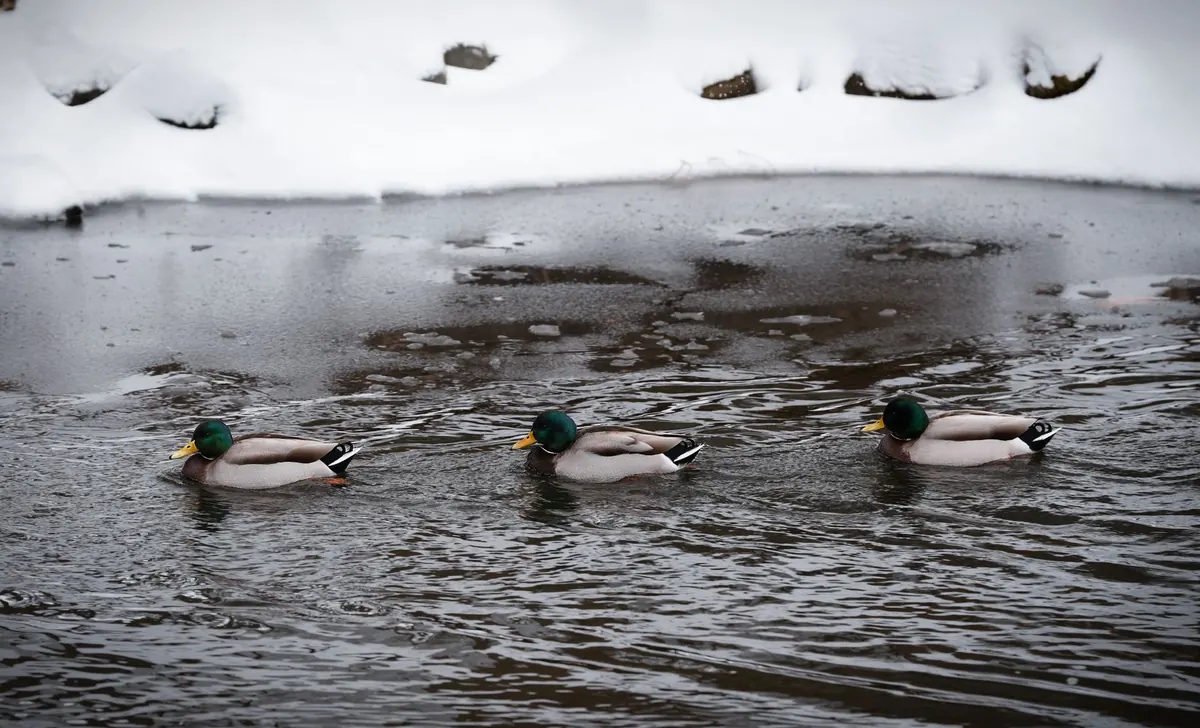
Colour is the last thing to trust at distance and the first thing to fail in dull light. Shape holds up better. Before you raise your binoculars, ask whether the bird sits high like a boat or low like a submarine. Dabbling ducks — Mallard, Teal, Wigeon, Shoveler, Gadwall, Pintail — sit high with a long body and a tail that often tips up. They feed by upending, head down and bottom in the air. Diving ducks — Tufted Duck, Pochard, Goldeneye, Scaup, Smew — sit lower, look compact, and disappear completely underwater, usually with a small forward lurch.
Leg position confirms it on land. Dabblers have legs set forward, so they walk awkwardly but capably around the bank. Divers have legs set far back and shuffle on their bellies, rarely straying far from water. A duck standing on the grass grubbing about is almost certainly a dabbler.
Heads and bills decide the tricky ones
Head profile is where similar ducks separate. The Tufted Duck's loose nape tuft and peaked crown are unmistakable once you have seen them, and the drake's black-and-white body and yellow eye confirm it. A Scaup is rounder-headed with no tuft, greyer-backed, and its bill usually lacks the white band that sits near the tip of a Tufted Duck's blue-grey bill. Female Pochard has a pale greyish face patch that female Tufted Duck lacks.
Bills are just as useful. Shoveler's enormous spatula is absurd at any range. Wigeon has a small, neat blue-grey bill on a chestnut head with a creamy crown stripe. Goosander, a sawbill rather than a classic pond duck, has a long red hooked bill and a slender body that sits low. Be ready for the not-a-duck cases, too: Coot is black with a white shield and bill, and jerks its head as it swims; Moorhen shows a red bill with a yellow tip and a white flank line.
Males, females and eclipse plumage
Between roughly midsummer and autumn, drakes moult into a drab eclipse plumage and can look startlingly like females. A drake Mallard in eclipse is brownish, but keeps a yellowish bill and often a hint of darker chest. All ducks moult their flight feathers at once and are flightless for a few weeks, which is why quiet, well-vegetated corners matter so much in late summer.
First-winter birds add another layer. Young drakes come into adult plumage patchily, so an autumn Tufted Duck or Pochard might be half-and-half for weeks. This is normal, not a rarity. Female and juvenile diving ducks are genuinely hard, and it is fine to record "female Tufted Duck or Pochard" and come back in brighter light.
Behaviour gives the game away
Watch a bird for a full two minutes before deciding. Does it dive cleanly, or does it dip its front end under and leave its rear in the air? Does it dabble in the shallows by the reeds or work the deeper middle? Does it graze on the bank like Wigeon and Gadwall, or dash about in fast, twisting flight like Teal?
Listen, too. A Wigeon's whistled "whee-oo" carries across a still lake, Teal give a sharp "krick", and Goldeneye drakes often announce themselves with a loud whistling of the wings in flight. Most male Tufted Ducks are largely silent, which is a useful negative clue in itself. On the water, grebes sit lower than any duck, have pointed bills and no obvious tail — a distant Great Crested Grebe in winter is a classic beginner's mistake.
Confusion pairs through the year
Learn the pairs, not the whole book. These are the ones that catch people most often:
- Tufted Duck and Scaup — check tuft, head profile, flank colour and the white bill band. Scaup is mostly a winter visitor to larger waters.
- Female Tufted Duck and female Pochard — look for the Pochard's pale face patch and browner, rounder body.
- Female Mallard and female Gadwall — Gadwall is greyer and neater, with a steeper forehead and a white wing patch in flight.
- Eclipse drake Mallard and female Mallard — bill colour and chest tone usually settle it.
- Goldeneye and Tufted Duck in winter — Goldeneye's head is triangular with a steep forehead; the drake shows a round white cheek patch.
- Feral domestic ducks and wild Mallard — park ponds are full of white, khaki and heavy-bodied birds, plus hybrids. Do not force an identification on something that looks wrong.
Season matters as much as plumage. Winter brings Wigeon, Pochard, Goldeneye, Goosander and, on favoured waters, Smew. Spring and early summer show birds at their brightest, while late summer is the season of confusion. Mandarin Ducks turn up on wooded lakes and rivers, and often perch in trees.
A routine for your next visit
Try the same approach each time and your identification speed will improve quickly:
- Stand back first. Note the light, the weather and the depth of water in front of you.
- Scan slowly with binoculars and count. Numbers and patterns are easier to remember than single birds.
- Pick one bird and stay with it until it dives, feeds or flies.
- Write down shape and behaviour, not just colours. A rough sketch beats a memory.
- Come back in a different month. The same pond in June and January is effectively two different places.
Good duck watching is mostly patience plus a notebook. Get the silhouette and the behaviour right, and the names follow.
Photo: David Kanigan / Pexels
Related posts
More stories you’ll love reading