



By late April, the first swifts are back in Britain, and by May the sky above towns and villages is busy with three different aerial feeders. Swallows and house martins have often arrived a few weeks earlier. All of them catch insects on the wing, all of them migrate from Africa, and all of them can zip past before you have time to focus. The trick is not to try to see everything at once. Work through the clues in a fixed order: shape, colour, behaviour, then voice.
Start with the silhouette
At a distance, silhouette is more reliable than colour. A swift looks like a dark boomerang or a bow pulled tight, with long, stiff, scythe-shaped wings and a short, forked tail. It has no obvious tail streamers and no white rump. A swallow has long, thin tail streamers trailing behind it, and its wings are more pointed. A house martin is compact and chunky, with a short, slightly forked tail and a bright white rump that shows up even against a grey sky. If you can see the rump, you are almost certainly looking at a house martin. If you can see streamers, it is a swallow. If you can see neither, and the bird is all dark, it is a swift.
Swift: all dark, all speed
Swifts are sooty brown rather than black, though they often look black in poor light. The only pale patch is a small throat, which is easy to miss. Their wings are long and narrow, held slightly back and often stiffened in a fast, flickering flap. They glide frequently, and they rarely flap and glide in the same rhythm as a swallow. Swifts do almost everything in the air. They feed, drink, mate and even sleep on the wing. They cannot perch on wires or fences, and they only land at the nest, where they cling to the entrance. That is why you will not see a swift sitting on a telephone line. Listen for the screaming parties: groups of swifts chasing each other around rooftops, giving a high, piercing sreee that rises and falls.
Swallow: streamers and a red throat
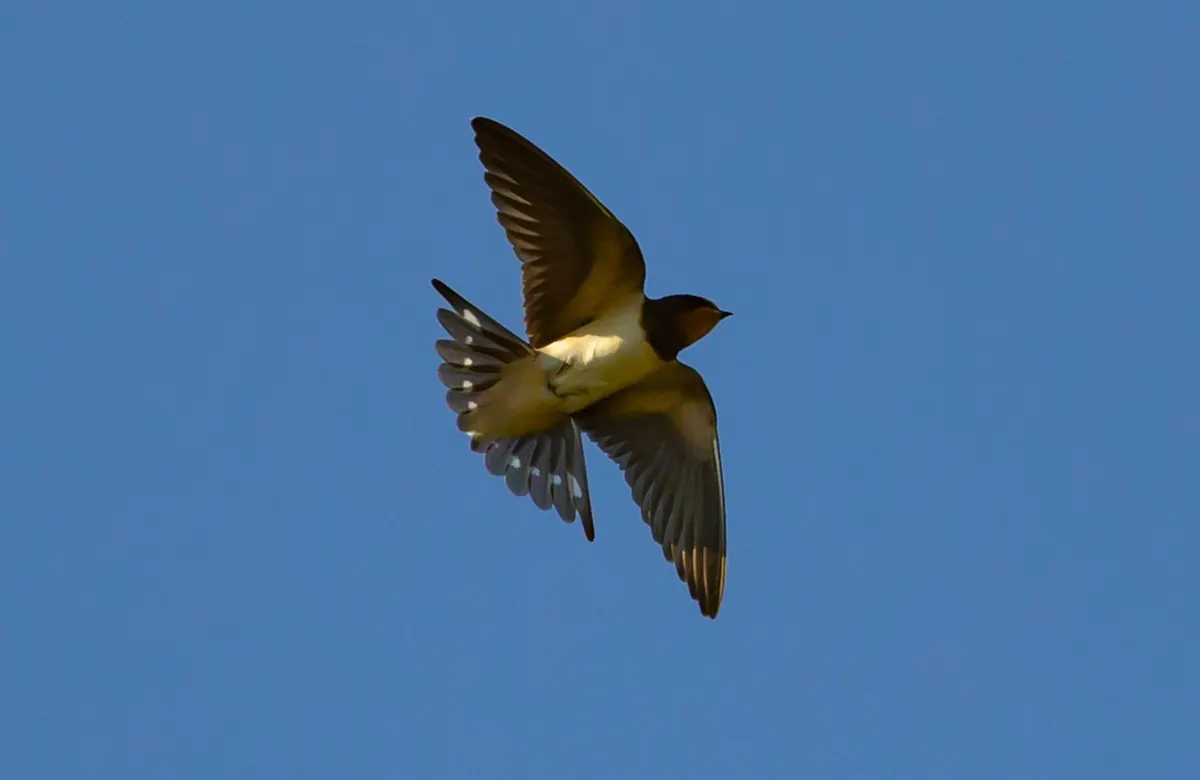
Swallows are glossy blue-black above and creamy white below, with a dark red throat and forehead. The tail is the giveaway: long, forked, and tipped with thin streamers that can be almost as long as the body in an adult male. Swallows fly lower than swifts, often swooping over fields, ponds and livestock, and they frequently perch on wires, fences and rooftops. They nest inside buildings, usually on a beam or a ledge, building a cup of mud and grass. Their song is a liquid, twittering warble, often delivered from a perch or in flight. If a bird is sitting on a wire and singing, it is almost certainly a swallow.
House Martin: white rump, short tail
House martins are neat, compact birds with blue-black upperparts, pure white underparts, and a conspicuous white rump. The tail is short and forked, but it has no long streamers. Their legs and feet are covered in white feathers, which you may notice when they cling to a nest. House martins fly with a fluttering, buoyant action, often around rooftops and eaves, and they frequently mix with swallows and swifts. They nest in colonies, building cups of mud under the eaves of houses, often in rows. The call is a dry, chattering prrit or trrrit, less musical than a swallow's song.
Flight and behaviour: reading the sky
Once you have the basic shapes, behaviour narrows things down. Swifts are the high-speed specialists. They often fly high, especially in fine weather, and their screaming parties are a sound of midsummer. Swallows are low-level hunters. They skim over grass, water and roads, turning tightly and sometimes following people or animals to catch disturbed insects. House martins are the middle layer. They fly around buildings, often lower than swifts but higher than swallows, and they frequently visit puddles and mud for nesting material. In a mixed flock, look for the white rump first, then the streamers, then the all-dark swift. That order works because the white rump is visible at the greatest distance.
Nests and calls: the final clues
If you find a nest, the mystery is usually over. Swifts use dark cavities under roof tiles or in walls, and they leave no mud. Swallows build an open cup of mud and grass inside a building, often on a beam. House martins build a closed mud cup with a small entrance hole, fixed under an outside eaves. House martins often nest in groups, while swallows are more likely to nest singly. Calls are just as useful. The swift's scream is unmistakable once learned. The swallow's song is a cheerful, liquid twitter. The house martin's call is a dry, rolling chatter. And if you see a small brown bird with a brown band across its white chest, flying around a sandy bank, that is a sand martin, a close relative of the house martin.
A field routine you can use
Next time you are out, try this simple routine. It takes a few seconds and quickly becomes automatic.
- Check the silhouette. Boomerang wings and no tail streamers: swift. Long streamers: swallow. Compact with a short tail: house martin.
- Look for white. A white rump means house martin. A red throat and pale belly mean swallow. All dark with a pale chin means swift.
- Watch the flight. High, fast and screaming: swift. Low, swooping and perching: swallow. Fluttering around eaves: house martin.
- Listen. A piercing scream: swift. A liquid twitter: swallow. A dry chatter: house martin.
- Check the nest if you can. Roof cavity: swift. Mud cup inside a building: swallow. Mud cup under the eaves: house martin.
With practice, you will separate them in a single glance. Until then, take your time, enjoy the noise, and remember that all three are summer visitors. They will be gone by October, so make the most of them while they are here.
Photo: TheOtherKev / Pixabay
Related posts
More stories you’ll love reading